
Orb weaver spiders in Canberra.
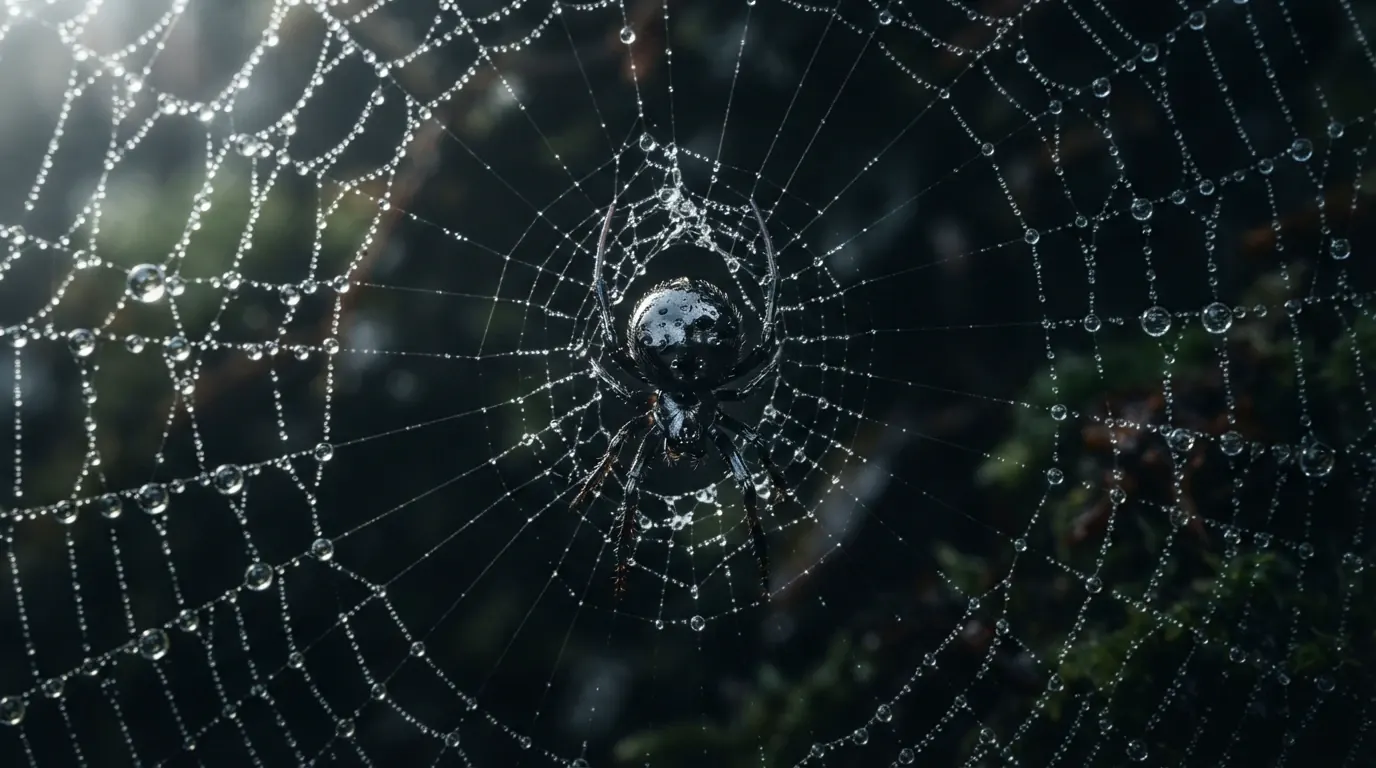
Orb weaver spiders (family Araneidae) are large, beneficial spiders that spin circular wheel-shaped webs in Canberra gardens, parks and bushland from late summer through autumn. They are among the most visible spiders in the ACT — identified by their large, wheel-shaped webs stretched between shrubs, fence posts and vegetation. Most people encounter them without warning, usually by walking face-first into a web strung across a path or driveway after dark.
A large family of garden spiders defined by the circular web.
Orb-weavers are classified under family Araneidae, with related species in Tetragnathidae (long-jawed orb weavers) and Uloboridae. What defines them is the orb web: a circular spiral of sticky silk laid over radial threads, with a central hub where the spider waits for insect prey.
Common genera
Argiope, Neoscona, Zygiella and Cyclosa, as well as the garden orb weaving spider genus Eriophora. All produce the characteristic spiral orb web to intercept flying insects.
Garden orb weaver — Eriophora transmarina
According to the Australian Museum, one of the most widespread orb-weaving spiders in eastern Australia and a familiar sight in Canberra backyards from February through May.
Golden orb weaver — Trichonephila species
Less common in the ACT than in coastal regions, but does appear in sheltered spots where food is plentiful through the warmer months. Recognised by the golden sheen of the web silk in sunlight.
How big do orb weavers get in Canberra?
Females are significantly larger than males across all species — a pronounced size difference that can catch people off guard when the same species looks completely different depending on the individual.
Garden orb weaver female
15–25 mm body length. Typically seen at the centre of the web or retreated to a curl of nearby leaf at the web edge.
Garden orb weaver male
Under 10 mm — much smaller than the female, and rarely seen as prominently. Often found at the web edge or nearby vegetation.
Golden orb weaver female
30 mm or more body length — the largest of the common Canberra orb weavers, and the one most likely to catch people's attention in the garden.
Golden orb weaver male
Roughly one-quarter the female's size, living on the edge of her web. Often overlooked due to the size contrast with the female.
Same team.
Written report.
Same technician where possible, a written report after every visit, and family-safe product used throughout — that's the standard on every job, not just the ones we quote carefully. Our technicians identify the spider species present and recommend treatment only where it is genuinely warranted.

How and why orb weavers rebuild their webs every night.
Orb weaving spiders produce silk from spinnerets at the tip of the abdomen and spin their large, circular webs at dusk or through the night. The web intercepts flying insects — flies, moths, cicadas and wasps — which become trapped on the sticky spiral. The spider waits at the central hub or retreats to a curl of nearby vegetation, detecting prey through vibrations along the silk threads.
Nightly construction
Many orb-weavers dismantle and eat their old web before dawn, recycling the silk protein to spin a fresh web the following night. A complete orb web can be constructed in as little as an hour.
Preferred web sites
Gaps between shrubs and along fence lines; near outdoor lighting that draws insects; across open paths where flying insects travel. Site selection is deliberate — webs are placed where prey density is highest.
Why you walk into them
This is why Canberra residents so often walk into webs across driveways or doorways after dark — the spider has had all night to span a space that was clear at dusk. Turning off outdoor lights reduces the insect traffic that attracts them to those spots.
Are orb weaver spiders good to have around?
Yes — for most Canberra gardens, orb weaver spiders are beneficial. They are efficient predators of flying insects including mosquitoes, gnats, moths and beetles, making a measurable contribution to pest suppression each night. The Australian Museum describes the garden orb weaver as beneficial for this reason. In our experience at TCB Pest Control, properties with established orb weaver populations tend to have fewer flying insects around outdoor entertaining areas.
How to treat an orb weaver spider bite.
Orb weaver bites are uncommon and generally mild. These spiders do not pursue people and only bite when physically pressed against skin — for example, when putting on clothing or shoes a spider has crawled into. Venom from common orb-weaving spiders is not considered medically significant for healthy adults.
Bite symptoms
Local pain and redness at the bite site. Minor swelling (oedema). Occasional nausea. Symptoms are typically mild and resolve without medical treatment in healthy adults. If you could not identify the spider, seek medical advice to be safe.
First aid steps
Clean the bite area. Apply a cold pack and rest. Seek medical advice if symptoms worsen, if there is an unexpected reaction, or if you could not identify the spider involved. Do not apply a pressure bandage to a spider bite unless directed by emergency services.
When to call a pest controller for orb weavers.
A lone orb weaver in the garden rarely needs professional attention. Canberra properties that back onto bushland, creek lines or dense vegetation tend to see the highest orb weaver activity from late January through April. Consider calling a pest controller when:
Webs in doorways nightly
Webs appearing every night in doorways and outdoor living areas, making the space unusable. Web-down treatment removes the immediate population and disrupts the cycle.
High numbers across the property
Spider numbers are high across the property — multiple active webs on eaves, fences and garden structures simultaneously. An inspection identifies the scope and which areas to target.
Unidentified species
You are finding species you cannot identify. If you are dealing with a mix of species — including ground-level hunters like the wolf spider Canberra residents commonly encounter — a single inspection gives you the full picture.
Web-down. On-site identification.
Targeted web-down treatment and perimeter inspection for properties where orb weaver numbers have reached problem levels. Low-toxicity product, same-week visits, and a written report after every job — only treating where treatment is genuinely warranted.
Book spider control today.
Tell us what you're seeing — webs in doorways every night, high spider numbers across the property, or species you can't identify — and we'll come back within one business day with a written quote and the next available visit. Family-run, fully licensed, family-safe product on every job.