
The Australian cockroach: identification and control in Canberra.
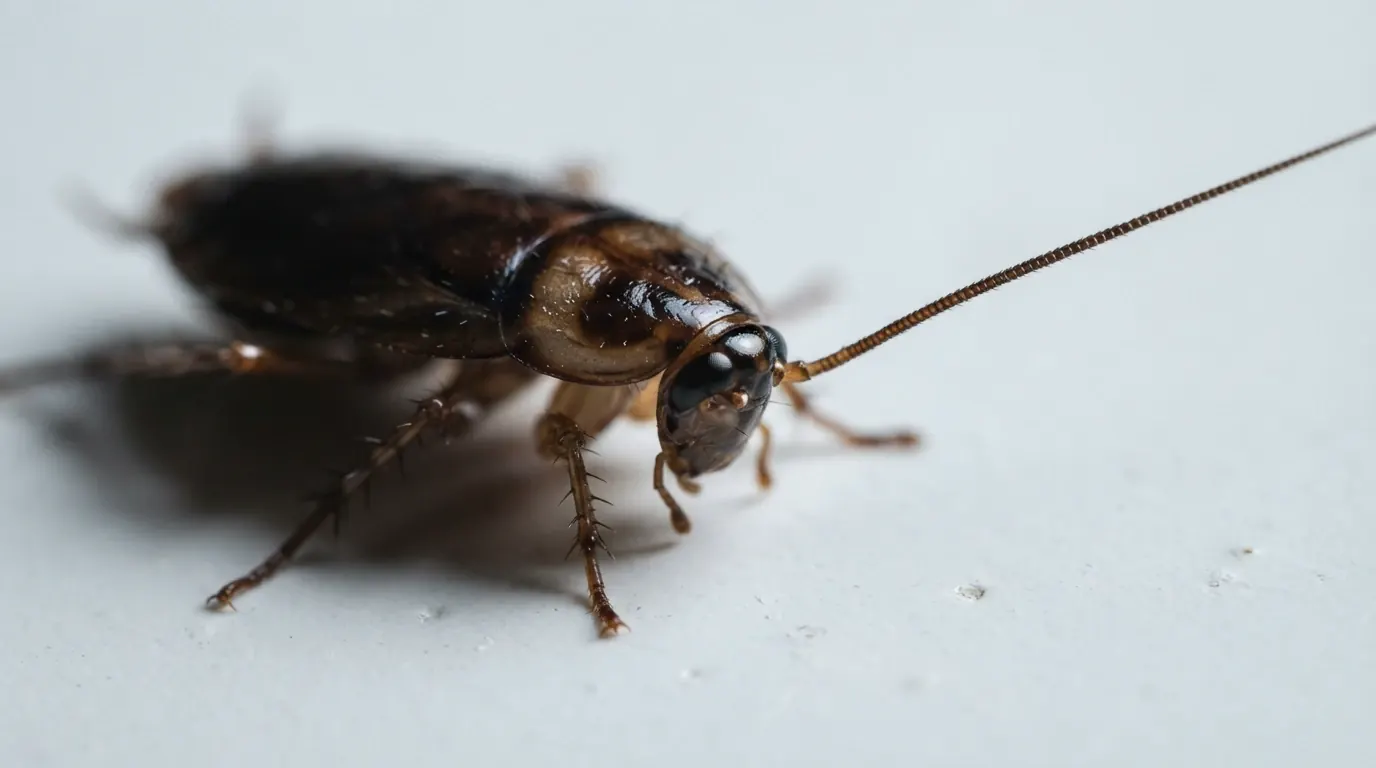
The Australian cockroach (Periplaneta australasiae) is a reddish-brown pest species identifiable by pale yellow markings on its pronotum and forewings. Despite its name, it is not native to Australia and most likely originated in Africa. Reaching 30 to 35 mm in length, it is common along the east coast and found in parts of Canberra — particularly outdoors in gardens, bark piles, and leaf litter — though it will move indoors when food or water is available.
Identifying Australian cockroach species.
The Australian cockroach may be easily mistaken for the American cockroach; the two share a similar reddish-brown colouring, but size and markings separate them clearly.
Size
The Australian cockroach is typically around 30 to 35 mm in length, while the American cockroach often exceeds 40 mm.
Pronotum border
The pale yellow border around the pronotum — the shield-like plate covering the thorax — is one of the clearest identification features on adult cockroaches.
Forewing stripe
The yellow markings along the forewing are the clearest identification features on adult cockroaches and distinguish this species from the American cockroach.
Nymph stage
Young Australian cockroach nymphs show pale yellow or cream patches on the abdomen, which fades as they develop into adults. This can make species identification harder at the nymph stage, which is one reason it is worth having a professional confirm what you are dealing with before treating.
Common cockroach species in Australia: native cockroaches and pest species.
Over 550 species of cockroach have been described in Australia, according to the Australian Museum. The great majority are native Australian cockroaches that live outdoors, many of them adapted to eating decomposing wood and leaf litter as part of natural ecosystems. The giant burrowing cockroach (Macropanesthia rhinoceros) is one well-known native Australian species found in bushland that poses no threat to homes or businesses. The reality in Australia is that cockroaches in Australia carry a reputation that most species do not deserve. The pest species that infest homes are a far smaller group. Common cockroach species in Australia found in Canberra homes and businesses are described below.
German cockroach (Blattella germanica)
Light brown with two dark longitudinal stripes on the pronotum, and the smallest of the common pest species at around 12 to 15 mm. The German cockroach is a common household pest found most often in kitchens and bathrooms. It breeds rapidly throughout the year and is the species most likely to be behind large-scale indoor infestations. Each egg case can hold up to 40 eggs, which is why numbers can escalate quickly.
American cockroach (Periplaneta americana)
Large and reddish-brown, similar in appearance to the Australian cockroach but larger, often exceeding 40 mm. The female produces an egg case containing up to 16 eggs and deposits it in a sheltered location. The American cockroach favours warm, humid environments such as drains, roof voids, and subfloor areas.
Australian cockroach (Periplaneta australasiae)
As described above, identified by its yellow markings along the forewing and pale pronotum border. Often found in kitchens and storage areas once it has moved indoors, particularly in properties with gardens that have mulch, bark, or leaf litter close to the building.
Oriental cockroach (Blatta orientalis)
Dark brown to black in colour, stocky, and strongly associated with humid conditions. It is commonly found in drains, cool damp rooms, and subfloor areas, and can spread bacteria in the same way as other pest species.
Smokybrown cockroach (Periplaneta fuliginosa)
Dark mahogany-brown and fully winged. Among the Periplaneta species found in Canberra, one exception is the smokybrown cockroach: it flies readily and is attracted to light at night. It is more common in warmer, coastal parts of Australia but does appear in the ACT during summer.
Are Australian cockroaches dangerous?
Same team.
Written report.
One quote, one visit, one written report. No call centre, no subcontractors — just the same local team that answers the phone. A technician will confirm the cockroach species present at your property and recommend a treatment plan suited to the specific infestation.
Signs of a cockroach infestation.
A cockroach infestation usually leaves physical evidence before you spot a live insect. Cockroaches are nocturnal, so seeing one during the day often means the population is already large enough that individuals are being pushed out of hiding by competition for food. Signs to look for include:
Droppings
Small, dark, cylindrical pellets in cupboards, along skirting boards, and near food sources.
Egg cases (oothecae)
Brown, capsule-shaped casings tucked behind appliances, in wall cracks, or in leaf litter near the building exterior.
Musty, oily odour
A musty, oily odour in confined areas such as under the sink, behind the fridge, or inside kitchen cabinets.
Shed nymph skins
Shed nymph skins, which accumulate in areas where cockroaches are harbouring.
Smear marks
Smear marks along walls or floor edges in areas with persistent humid conditions.
Do Australian cockroaches fly?
Adult Australian cockroaches have fully developed wings and can fly, but they do so infrequently. Flight typically occurs when the insect is disturbed or when ambient temperatures are high. Most movement is by running. Cockroach nymphs cannot fly at any stage, as their wings are not yet developed. Of the pest species in Canberra, the smokybrown cockroach is the one most likely to fly readily and enter homes through open windows or gaps around light fittings.
Identifying common species for effective cockroach control.
How to get rid of cockroaches in Canberra.
One species.
Targeted treatment.
The Australian cockroach responds to perimeter spraying, dust treatments in roof voids and subfloor spaces, and reduction of outdoor harborage — not the same approach as a German cockroach infestation. TCB Pest Control identifies the species first, then treats accordingly.
Book cockroach control today.
Tell us where you are seeing them — garden, subfloor, kitchen — and we will come back within one business day with a written quote and the next available visit. Family-run, fully licensed, family-safe product on every job.