
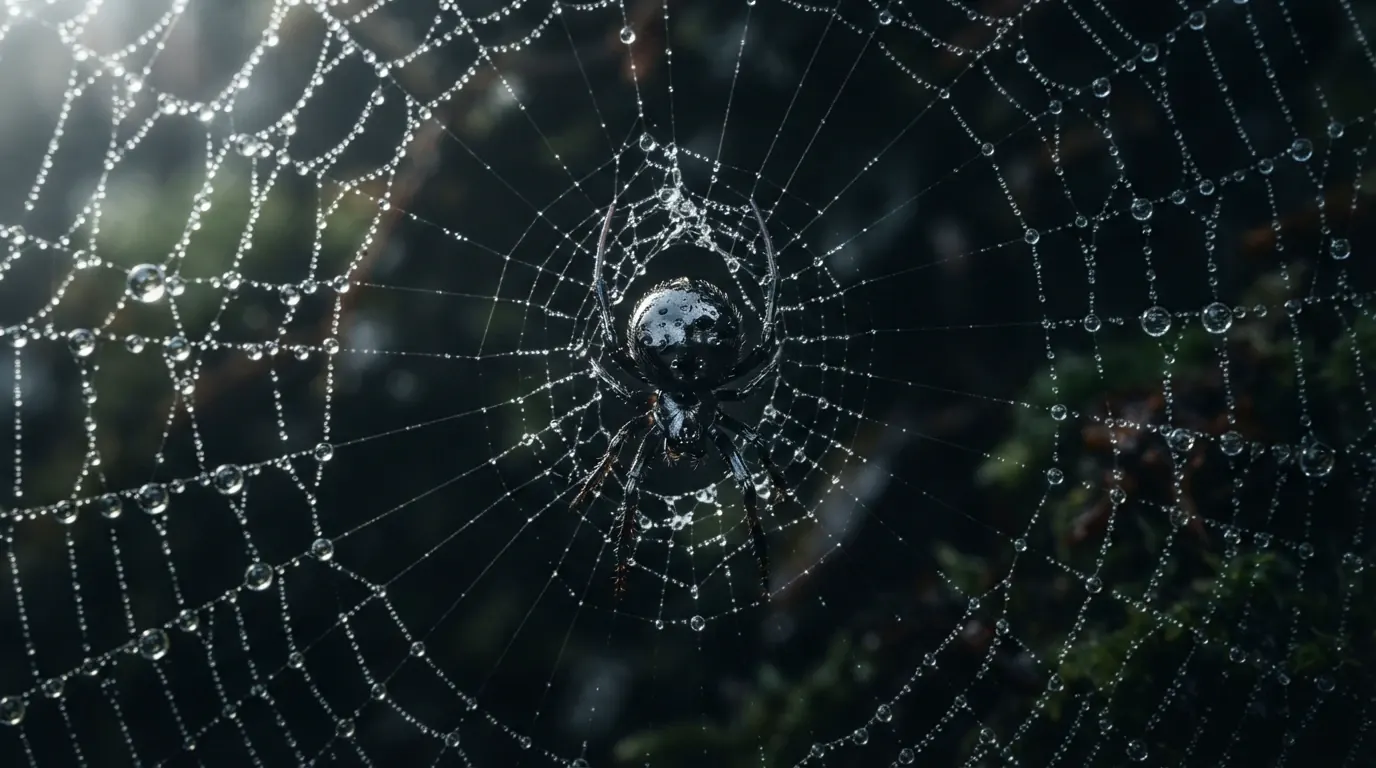
Garden orb weaver spider in Canberra.
The garden orb weaver (Hortophora transmarina) is Canberra's most common nocturnal web-building spider — a harmless, widespread invertebrate found in suburban gardens, parks and bushland edges from late summer through to autumn. Its large, wheel-shaped webs appear between trees and shrubs after dark, and it earns its place in the garden by keeping flying insect numbers in check.
Reddish-brown abdomen, pale leaf marking, banded legs.
The garden orb-weaver is one of Australia's most widespread spider species, found throughout Canberra's suburban gardens, parks and bushland edges. Despite being so common, it is regularly misidentified — colour variation between individuals is pronounced, and the species was itself reclassified relatively recently.
Abdomen & colouring
Large, rounded abdomen — typically reddish-brown or grey, and occasionally almost black. A pale, leaf-shaped marking runs along the dorsal stripe. Leg banding is a consistent feature, though the overall colouring varies enough between individuals that misidentification is common.
Size — female and male
Females can reach around 25 mm in body length, making them noticeably larger than males. The size difference between sexes is pronounced across this species, and it is usually the female that people encounter at the centre of a large web.
Silk and spinnerets
Silk is produced from spinnerets at the tip of the abdomen and drawn into threads as the spider constructs each wheel-shaped orb web. The spiral of sticky capture silk is laid over non-sticky radial threads, with a central hub where the spider waits for prey.
From Eriophora to Hortophora: how the name changed.
The garden orb weaver's scientific name has changed following a formal taxonomic revision. Understanding the reclassification helps when cross-referencing Australian Museum records, pest management literature and older identification guides — all of which may use either name.
Family Araneidae
According to the Australian Museum, the garden orb weaver belongs to the family Araneidae within the order Araneae — the true orb-weaving spiders — and is among the most common spider species encountered across eastern Australia.
The genus revision
The genus Hortophora was separated from Eriophora following a taxonomic revision by Framenau, Baptista, Oliveira and Castanheira. Older references describe this species as Eriophora transmarina — both names refer to the same spider.
Hortophora transmarina
Hortophora transmarina is now the accepted name for the Australasian garden orb-weavers. It is one of the most widespread spiders in Australia, found from Queensland through New South Wales and into the ACT and southern states.
Same team.
Written report.
Same technician where possible, a written report after every visit, and family-safe product used throughout — that's the standard on every job, not just the ones we quote carefully. Our technicians identify the spider species present on site and recommend treatment only where it is genuinely warranted.

Web locations, day habits and nightly reconstruction.
The Australian garden orb weaver is found across eastern and southern Australia and is a familiar sight in Canberra from late summer through to autumn. They spin intricate webs between trees and shrubs, along fence lines, under eaves, and across paths — often at face height.
Preferred web sites
Gaps between trees and shrubs, along fence lines, under eaves and across open paths. Web placement is deliberate — the spider selects sites where flying insect traffic after dark is highest, which is why webs so often appear at face height across driveways and doorways.
Daytime retreat
During the day the spider retreats to a folded-leaf shelter at the edge of the web — a curl of foliage where it waits, largely hidden, until after dark. This is why you often don't see the spider on the web during daylight hours.
Nightly reconstruction
After dark the spider moves to the centre of the web to wait for prey. This nightly reconstruction of the orb web happens most nights, keeping the spiral capture threads fresh and maximally sticky — which is why a cleared web often reappears the following morning.
How the garden orb weaver uses silk to catch insect prey.
This spider is an ambush predator. It relies on sticky silk to catch prey that flies through the garden after dark, and on spider senses to detect when an insect hits the web — vibrations through the threads draw it to the point of contact to bite and cocoon the catch. For this reason, a garden orb weaver positioned away from high-traffic areas is genuinely useful to have around.
Moths and flying beetles
Larger flying insects drawn to outdoor lighting at night are the primary prey — moths and flying beetles form a large share of the diet and justify the web's position near light sources.
Mosquitoes and midges
Smaller flying insects including mosquitoes and midges are regularly caught in the fine spiral threads, making the garden orb weaver a genuine ally in keeping biting insect numbers down around outdoor entertaining areas.
Cicadas and wasps
Larger, harder-bodied insects including cicadas and wasps are also taken — the spider's venom immobilises prey quickly before it can tear the web structure.
Other flying insects
Any flying insect passing through the garden at night is a potential target. The web's large surface area maximises the chance of interception across the full range of prey that moves at night.
One season. One egg sac. One spring of spiderlings.
The garden orb weaver completes its life cycle in a single year. Understanding the timing helps explain why Canberra sees a clear peak in spider activity between January and April, and why populations can seem to appear suddenly on a property that had few spiders the previous season.
Egg sac
Females produce a silken egg sac in late summer or autumn, attaching it to bark or foliage near the web. The egg sac protects the eggs through the cooler months until conditions are right for hatching. Adults typically complete just one season.
Spiderlings and ballooning
Spiderlings hatch the following spring, spin tiny orb webs to establish a territory, then disperse by ballooning — releasing a silk thread to catch the wind and travel to new locations. This is how a garden with no visible spiders in winter can have a significant population by February.
Canberra peak season
In Canberra, populations are most visible between January and April, which aligns with the peak of spider-related callouts each year. Properties backing onto bushland, creek lines or dense vegetation tend to see the highest activity.
Are garden orb-weavers dangerous?
This garden spider is not considered medically significant. It is not aggressive and rarely bites unless pressed directly against skin. A bite may cause local pain and occasional mild nausea, but serious reactions are uncommon. For most people, the concern is more about the webs than the spider itself.
Bite symptoms
A bite may cause local pain and redness at the site, minor swelling, and occasional mild nausea. Serious reactions are uncommon. The spider is not aggressive — it will typically drop from the web and curl up rather than confront a person. If you cannot identify the spider that bit you, seek medical advice to be safe.
Confusion with wolf spider
The garden orb weaver is sometimes confused with the wolf spider in Canberra, which is a ground-dwelling species from a completely different family. Wolf spiders carry their egg sacs and spiderlings on their bodies rather than building webs — a key distinguishing feature.
When to call a pest controller for garden orb weavers.
One garden orb weaver is rarely a problem. A large number of webs across entryways, children's play equipment, or outdoor furniture is a different matter — particularly when you cannot confidently identify what you are looking at.
High numbers in shared areas
Webs appearing nightly across entryways, children's play equipment or outdoor dining areas make those spaces unusable. Web-down treatment removes the immediate population and disrupts the cycle — clearing webs by hand without treating harbourage areas produces only short-term relief.
Unable to identify the species
When you are not confident what you are looking at, a professional inspection gives you the full picture. A mixed population — including ground-hunting species — warrants an assessment before deciding on the right treatment approach.
Recurring spider pressure
If spiders are a recurring issue around your Canberra property each season, our team treats the surfaces spiders travel across with targeted residual products and addresses harbourage areas around the building — producing lasting results rather than just removing webs by hand.
Web-down. On-site identification.
Targeted web-down treatment and perimeter inspection for Canberra properties where garden orb weaver populations have reached problem levels. Low-toxicity residual product, same-week visits, and a written report after every job — treating only where treatment is genuinely warranted.
Book spider control today.
Tell us what you're seeing — webs in doorways every night, high numbers across the property, or species you can't identify — and we'll come back within one business day with a written quote and the next available visit. Family-run, fully licensed, family-safe product on every job.